
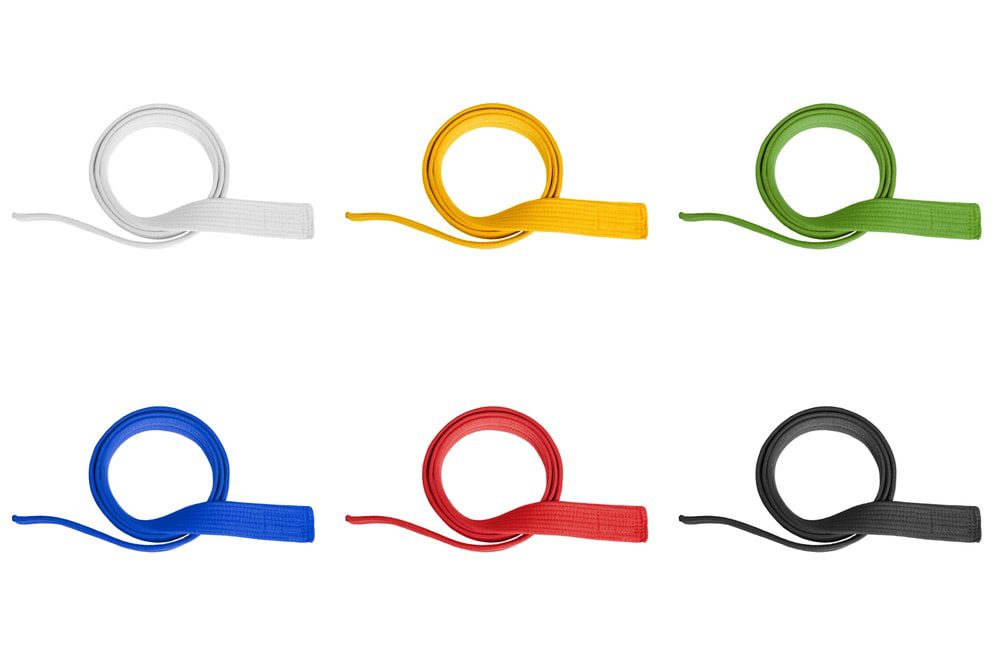
TAEKWONDO BELTS ARE CATEGORIZED INTO THREE CATEGORIES:
Gup is the rank of the colored belt.
Poom is the junior Black Belt for students under the age of 15.
Dan – the Black Belt level is only open to students over 15.
Within each of these three types, there are several belts and ranks.
Your Taekwondo school may have a different taekwondo belt system structure within those three ranks than mine. But don’t worry – you can’t go wrong as long as you have a basic understanding, the school is legitimately accredited, and the teacher is knowledgeable.
I go through each of these types and the taekwondo belts and grades inside them in more detail below. So keep reading to find out more.
Three Main Taekwondo Belts Categories
Understanding the significant ranks and the belts that come under them can be challenging, so I’ve broken down a standard Taekwondo school belt structure. Even if there are a few gaps, the school should have something identical.
1. Gup rank
All students of Taekwondo begin with the Gup level. What is the Gup rank, and why is it important? Additionally, it is occasionally referred to as the “Kup” or “Geup” rank – both of which translate as “grade.” This is the lowest rank in Taekwondo. Students must work their way up the Gup rank’s nine ranks or grades. The first taekwondo belt is white, while the final belt they earn before progressing to the Poom level is usually red with a black or white stripe. You can anticipate the belt sequence to look anything like this:
- White belt
- Yellow belt
- Yellow belt with a green stripe
- Green belt
- Green belt with a blue stripe
- Blue belt
- Blue belt with a red stripe
- Red belt
- Red belt with black or white stripe
2.Poom
poom is effectively a transitional or intermediate rank for students transitioning from junior color belt grades to adult degrees. For example, if a Taekwondo student attains Black Belt but is under 15, he is given the Poom level.
The Poom taekwondo belt means that a student has fulfilled both academic and competence standards but does not exhibit the same degree of self-defense capacity as an adult. Being given a Poom belt before the age of 15 is an achievement. Students who do so demonstrate tremendous potential in the sport of Taekwondo.
3. Dan’s rank
Therefore, you can anticipate the belt sequence to look anything like this:
- 1st Dan Black Belt is generally checked for a year after earning the final colored belt or Poom Black Belt.
- After 3 to 4 years of experience, the 2nd Dan Black Belt is typically checked for.
- After 4 to 5 years of preparation, the 3rd Dan Black Belt is usually checked for.
- After 5 or 6 years of experience, the 4th Dan Black Belt is typically checked for.
- After 6 or 7 years of preparation, the 5th Dan Black Belt is usually checked for.
- After 7 or 8 years of preparation, the 6th Dan Black Belt is typically checked for.
- After 8 or 9 years of experience, the 7th Dan Black Belt is typically checked for.
- After 9 or 10 years of preparation, an 8th Dan Black Belt is usually checked for.
- After 10 to 12 years of practice, a 9th Dan Black Belt is typically attained.